Showing posts with label social media. Show all posts

Tuesday, January 5, 2016

Handling a Social Media Blunder

Even the most careful of people trip on their feet. That is to say, businesses aren’t exactly protected from making mistakes online. Some do falter, and sometimes it yields grave effects.

Learning how to handle these blunders can help alleviate the situation and can restore your relationship with your audience. Take note of these helpful tips:

Let people talk
Don’t fuel their hate by deleting and suppressing negative feedback. Let them air out their frustrations.

Acknowledge and Apologize
The thing that drives people nuts is when a business doesn’t own up to its mistake and defends itself against negative comments. When you make a mistake, let your pride down and apologize to your audience, especially to those who were directly affected. When people see that you admit your error, their fury will die down eventually.

Reach out
But apologizing isn't the only thing you should do. You have to reach out to your audience to further extinguish the flame. Respond to negative tweets or comments; the more personalized and sincere your responses are, the better.

Monitor the crisis
Usually, the quicker you act, the faster people forget, but that will always depend on the circumstance and the gravity of the situation. Keep monitoring your social media to learn how to manage the crisis more effectively. There are programs you can use to make monitoring easier for you.

Create Powerful Content
After you’re done extinguishing most of the flame, it’s time to create content in form of article, images, videos or infographics to bury all negative effects of the blunder and revive your social media presence.

Seek help when needed
When your business can’t manage the crisis on your own, you can hire an agency that can assist you in responding to the crisis. 9DotStrategies offers an Online Reputation Management service that can help you gain back your former glory.


Remember, it’s best to plan beforehand to limit the damage caused to your reputation. But when disaster strikes, contact 9DotStrategies!

Tuesday, February 18, 2014

Social Media Improvement Case Studies

Case studies are a great way to observe what type of strategy and tactics work for specific market segments. We all start from the beginning and some times, it benefits our business if we learn from another team’s successes and mistakes. Case studies are excellent reading material to help you decide if a planned marketing plan will most likely work or not.


There are a couple of case studies that revolve around specific social media campaigns like those done on Facebook, both with and without the help of paid ads.

Sample Case Studies to Analyze


If you have a couple of marketing plans for your Facebook fan page, you can go over these sample case studies to help you understand what type of methods work. You can also understand that you don’t need to spend a lot of money in order to have a successful run on Facebook.

•    Social games always increase interest over a product, especially if they tie in smartly to your actual offering. A parking game launched in 2007 greatly increased the awareness of a TV show about parking. Inviting friends to get more points, sharing your accomplishments to get free upgrades are a fantastic way to gain free traction for a project.

•    The Ikea Facebook Showroom campaign launched last 2009 allowed people to tag their names onto pieces of furniture that they want to win in a raffle. It was a very successful and viral campaign that didn’t even involve spending for Facebook ads.

•    Oreo’s Twitter campaign in line with their 100th birthday pitted the cookie vs. crème part of the popular snack. Their Twitter campaign was timed during Super Bowl, which helped increase their overall follows not just on Twitter but also on Instagram.

Create your own Case Studies

If you want to create your own case study for your own marketing campaigns, note the following 3 essential types of a good case:

•    Statement of the problem or current situation
•    Planned and implemented solution
•    Objective statement of the outcome (preferably in quantifiable and measurable facts)

Start recording data that you get from Facebook Insights with every campaign that you launch and remember to give your marketing plan a few days to mature in order to see the best results.

What makes a successful Social Media Campaign?

The key elements in making a good social media campaign are:

•    Have one focused face of your campaign
•    Pick a prioritized and primary platform for your campaign (most if the time, Facebook)
•    Think of your content first then conversion as a second priority

Remember that consumers are a lot smarter now and that they expect a lot more from the marketing teams today.

Tuesday, January 21, 2014

How SEO is influenced by Social Media

Google levels the playing field and it is in favor of the smaller but smarter players. You can rank as high as how Amazon ranks if you know how to leverage and maximize the influence of social media into your search engine ranking.

Curious and excited to know how you can beat the big guys? Here’s how.


Google+ is your new best friend

Add a Google+ button in every single page of your site. Don’t have a Google+ account yet? Create one!

Google’s very own social media allows you to recommend links and content to your peers, and it shows up in their Google results when they are logged into their Gmail accounts. Even if you believe Facebook has the higher traction, it does not hurt to start sharing articles into your Google+ circles today.

Increase your index time

Boost the visibility of your content when you share them through Facebook, Twitter, Instagram and even Pinterest. It is easier to find content via these sites (and domains) as compared to ordinary blog posts. What this means for you is that Google finds you faster and therefore, ranks you faster, compared to doing things on your own.

How can you help yourself through social media?

•    Post a link of your latest update through Facebook and Twitter
•    Include a Facebook recommend or Twitter tweet button at the end of every page to encourage sharing
•    Create witty hashtags associated to your brand and use them with every photo and link you post
•    Ride on trending hashtags like #ootd and #tbt
•    Share other site’s contents on your own social media feeds, give them credit and then link it back to your own products

SEO via social media presence gives your brand more personality and brings you closer to your audience. It also strengthens (and creates) emotional connection to your products easily.

More shares = improved ranking

Resist the temptation to run promos that require people to share or re-post images from your site. This is viewed as a cheap way to get traffic. You can encourage sharing without being in your face by banking on UGC or User Generated Content.

How can you do this?

You can try running a promo where people can submit their own photos using a hashtag for your product. This will generate enough buzz for your product without being too much of a hard sell.

Shared contents within your pages rank higher in the eyes of Google. You will notice that in your typical Google search today, at least one item in the first page of hits has a social media link to it. SEO is really influenced by social media, especially when it comes to determining the relevance and credibility of a site.

Social bookmarks means more foot traffic

Liked pages of Facebook and followed Twitter feeds are disguised bookmarks to your pages. The more interesting your posts are, the more intrigued your readers will be and therefore, the more they will view their post.

Avoid being marked as spam by your audience by only posting about what is relevant and by not posting more than 4 updates within a day. Normally, just 2 per day is fine. Don’t force an update if you don’t have one.

You can still generate social media traffic by answering questions on posts, commenting on other people’s post and sharing links from other nice and yet related sites to your own.

Personalized search results

Probably one of the biggest reasons why Google thinks social media content is relevant in SEO today is that it provides a personalized search results list. Google prioritizes what your friends have recommended, what is trending in your current location and the like.

Photo By: Ted Nguyen USA

Sunday, January 12, 2014

Advantage in using Pinterest

Definitely a breakout site this 2013 that nearly everyone has a new account on is Pinterest. The same way that Google Images is rapidly increasing in usage, people are gravitating towards Pinterest to get advertising pegs, home décor ideas, party favor inspirations and even wedding photography guides today.

People go to Twitter for quick updates, they go to Facebook for mostly everything else but they go to Pinterest to look for inspiration. This is a great type of audience that is very easy to convert into actual sales.


What are the advantages of using Pinterest? Should your company have its own Pinterest board today?

Stats you need to know

If you are not convinced that Pinterest is rapidly gaining online popularity, read through the facts below:

•    Currently the 3rd biggest social network, after Facebook and Twitter (with Instagram a close 4th)
•    More than 60% of Pinterest users are female, making it very attractive for those targeting the female audience
•    CTR or click-through-rates are higher in Pinterest compared to Facebook and Twitter
•    Referrals from Pinterest are inclined to spend 10% more than those referred via Facebook or Twitter

When people land on Pinterest, they stay longer in the site to view images in detail or to save photos to their own pin board. This creates a longer time of engagement with your products as compared to the constant scrolling motion associated when viewing feeds on Facebook or Twitter.

Top 5 marketing advantages via Pinterest

Create your own Pinterest account for your online product today and you can expect the following positive effects to your business:

•   Increased interest for your products since you are given customers an idea how to use your products
•    Greater online traffic to your own website, if you include a link to your site from your pins
•    Improved viral quality to your online posts since pins on Pinterest are often shared to other social networks
•    Better visibility for your brand for free!
•    Prolonged engagement with your brand and its photos

It is not just a free advertising tool for you but it is also a great way to interact with your customers online in a very visual manner.

Some great examples on how to take advantage of mood boards on Pinterest are:

•    Party table setups, with close up shots of floral centerpieces, for a flower shop
•    Mix and matched outfits from the same season collection for a clothing store, all shot outside a studio
•    Different bathroom setups using candle sticks for a candle maker
•    Mason jars used as a drinking cup, floral vase, candy container, candle holder etc. for a home supplies store
•    Dramatic to simple eye make up during engagement shoots for a make-up company


Pinterest Tips

Expect improved website traffic to your site from Pinterest after following these tips:

•    Add descriptive words to each Pinterest posts, the same branding words used for your product, if possible
•    Create “how to” articles on how to use your products and best practices
•  Design inspirational and aspirational photo shoots to post on Pinterest to generate emotional connection to your customers
•   Make yourself visible and active on Pinterest by following relevant boards and commenting on other posts, too.
•    Inject a bit of personality to your Pinterest profile – target your audience!
•    Limit the width of your post to 540 pixels
•  Use narrow images compared to wider ones since most images are viewed via mobile, where horizontal scrolling is troublesome


Take advantage of the visual nature of Pinterest to create a strong, emotional bond to your products. Images have lasting effects on people compared to just written words so make sure that they have a very strong image of your product branding when they leave the site.

Photo By:  WiBBLE

Monday, June 24, 2013

How Social Media Signals Play A Part In Your Rankings

Two years back, #seo expert Danny Sullivan explored how #socialmedia signals affected search engine rankings. Back then, he surmised that while Facebook remains irrelevant to Google, retweets has become an invaluable part of building links. Immediately after, Google mogul Matt Cutts confirmed that organic SEO is indeed influenced by social media signals.

Although many SEO professionals are still evaluating the extent of social signal’s effect on rankings, various research studies prove that they are correlated to an increase in site traffic, rankings, and consequently, revenue.

Image From: http://socialmetricspro.com/wp-content/uploads/2012/08/connection_ssignals_seo.jpg


Social signals affect rankings in two ways: direct and indirect. Direct social media ranking signals include:

·         Facebook likes and shares
·         Twitter followers and retweets
·         Tweets where your brand is indicated or which pertain to a linkback to your site
·         Individuals who included you in their Google+ circles

On the other hand, indirect influence is directed by these factors:

·         Inbound links and mentions

This is the most important role of social media. The more linkbacks and social media mentions you procure, the more brand awareness and online visibility you raise. In fact, inbound links , especially from high quality sites, are far more important as a ranking criteria than social media and Matt Cutts has made this pretty clear.

·         Positive feedback in Google, Yelp and other similar sites

Through social networking channels, businesses are able to create a distinct and presentable image for their brand. More importantly, it allows them to establish genuine customer connection and trust and boost customer loyalty. This is turn, increases the likelihood of more positive reviews on sites like Google Local and Yelp.

Positive reviews mean satisfied customers. The number of positive feedback directly affects local and national search rank. The more satisfied clients you have tweeting about you or promoting you on their Facebook accounts, the better chances you have of attaining a higher ranking.

·         Less bounce rate and longer visitor time on website

Decreased bounce rate means visitors are pleased with your web content, thus compelling them to spend more time on-site. Similarly, if more consumers are aware of your brand through social media, then the higher chances you have of acquiring repeat visits, and the longer time-on-site you have. Google is able to accurately gauge if a website did satisfy customer queries and how many repeat visits there are to the same site, which makes this metric an effective tool for increasing organic search ranks.

There’s also that recent implementation of Google AuthorRank, which is aimed at identifying credible authors so that their content do not just receive higher search engine rankings, but also give more value to their outbound links.


While the impact of social signals are still under continuous study, their expanding role in algorithms that pertain to ranking can not be denied. Companies who welcome social media signals with open arms and eyes have been proven to enjoy wonderful benefits in terms of lead conversion, customer loyalty and awareness, word-of-mouth advertising and ultimately, profit.

Wednesday, June 19, 2013

Use Social Media to Increase Search Ranking

As a webmaster, you must know by now that search engine rankings are extremely important to your business. When you are at least within the top ten search results, this could mean more ads, more customers, more brand awareness, and thus, more revenue. But nowadays when everyone has gone social, merely ensuring that your site is well-optimized isn’t enough. You ought to ride the trend and be active in #socialmedia as well.

While the subject is still under debate, more and more studies reveal that the impact of social media on search ranking results can not be undermined. For instance, a recent survey by #moz showed that when websites started using various social media channels, their search engine rankings rose up to 14.63 points, specifically for those with Google+ business pages. Those who merely have Google+ buttons saw an increase of over 9 points.


Image From: http://a398.idata.over-blog.com/5/53/10/07/Why-Does-Social-Media-Affect-Search-Rankings---4-Most-Likel.png

How exactly does this influence occur? Well, for one, not only are those who have huge followings on social networking channels sharing information through word-of-mouth, their presence also influences search results based on the information they spread. Also, with recent Google developments, securing top ranking for social media influence is now more significant than being on the top spot for keywords.

Lastly, there’s a direct correlation between the size of your social network and YOUR search results. The bigger your network is and the more social media channels you engage in, the better your ranking will be. See, by regularly sharing information on social networks, you’re enjoying free re-advertising by your peers via organic search. Whenever prospective clients search for related keywords, the information you shared with your followers goes all the way up to your prospects.

As a business, how do you leverage on such reality?

•    Create positive connections with your clients and prospective clients

There is no better time than now. Make use of feedback forms on your website, soliciting in the process their Facebook and Twitter IDs.

•    Don’t link to or share your rivals

Remember, things have changed now. While it was considered healthy to engage in a friendly will-follow strategy before so you can spy on your rivals, doing so now will allow them to affect your connections and future clients. If you really wish to do so, mention them only on no-follow websites.

•    Share your key content on social networking platforms

This holds true especially for those entries that you are aiming to aggressively market to customers. Be sure to link them up on your Twitter and Google pages at the very least.

•    Keep content meaningful

Although there’s no hard evidence that a socially shared link containing good content is significant to social ranking, it’s not going to do you any bad either if your provide great content that’s targeted towards content association and follower shares.

Monday, June 3, 2013

Making Social Media Work for your Business

Some people think that social media is merely a temporary fad that will go out of style once people grow tired of it. However, marketers see it as a new long-term channel for effective product and brand promotion – and for good reason. Platforms like Facebook and Twitter are built on interaction between people – customers, prospective clients, their friends and families. It’s easier to spread the word about your business through such connections than any other online means.

Thus it only makes sense that companies utilize social media marketing in order to boost business. The role of social media in marketing relies on the type of business one has and how it suits company requirements. The extent of its efficacy also depends on how much time and effort you put into it. Remember that SMM only works if you dedicate a portion of your hour daily into it. Otherwise, momentum is lost.
                                 Image From: http://www.pinnaclecart.com/wp-content/uploads/2012/12/social-media.jpg

B2B businesses find it hard to cope with SMM. A research done in 2008 shows that around 69 percent of B2B consumers rely on social channels like Facebook for purchasing-related decisions. Given that fact, B2B firms can not simply disregard the need for them to use SMM as a dynamic means of spreading the word about their business.

There’s no better time to start than now. Networking through friends and their connections is now easier than ever. Potential customers can now be reached and they can find you as well in a click of a mouse. Various communities and platforms are available to help you in your promotional activities.

When it comes to video marketing, no other site beats YouTube for interacting with customers and eliciting viral responses. Use this to your advantage, and use it wisely so as not to scare customers away. Your uploaded videos must not only be a pulpit for discussion, but should also offer value.

Another effective marketing tool is Facebook. Perhaps the most widely used social platform in the world, Facebook’s power to make or break a business is unimaginable. With over 140 million users across the globe, your chances of being able to disseminate information about your products and businesses are limitless.

Last but not the least is Twitter. Nurturing one of the most rapidly growing online communities on the Web, Twitter is an excellent venue for both communicating with customers and promoting your brand. With more than a million subscribers (and growing), it’s no wonder how businesses are reaping enormous benefits using this website.

Monday, February 18, 2013

Quick and Dirty Notes on Web 2.0

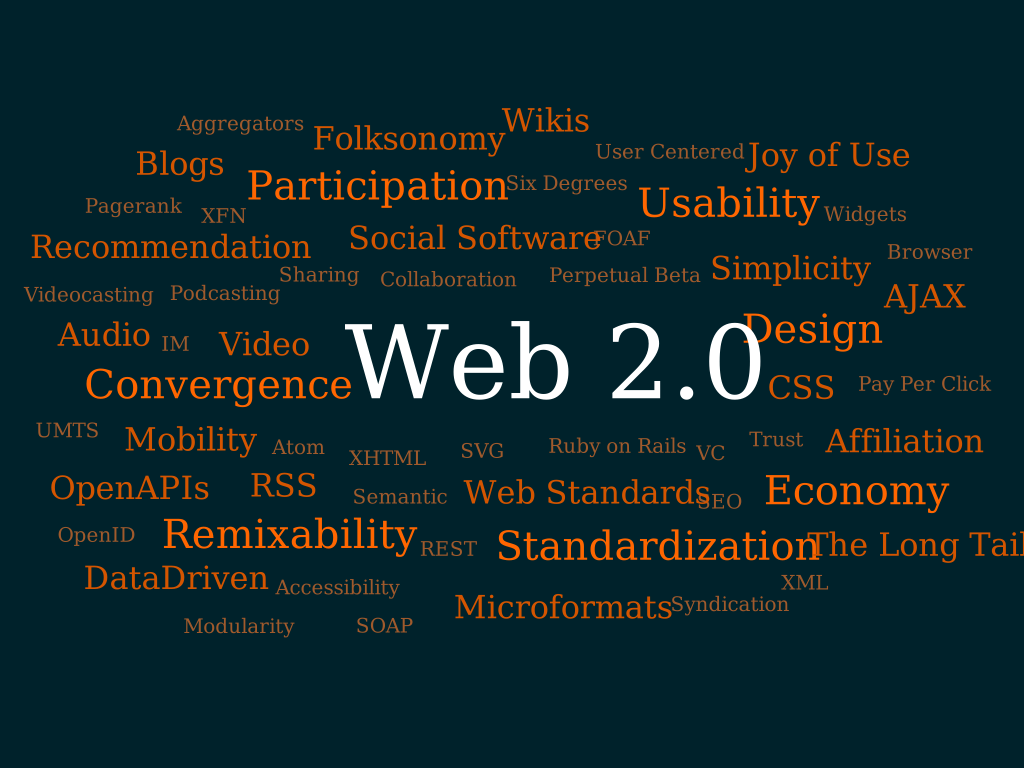
If you’ve been to another planet between 1999 to present, you might be wondering, “What is Web 2.0?” But for many of us earthlings who have been long around to witness the not-so-gradual transitions and developments in web technologies, Web 2.0 simply means the web as we now know it, a place where everyone and anyone can be connected, with all its interactive features like Facebook, IM, blogs, RSS, SEO and all those other cool digital things that we love.


Image Credit:Wikipedia

This widely-used jargon originated from Tim O’Reilly during a 1999 brainstorming session among O’Reilly Media and MediaLive International, where it was referred to as an updated version of the World Wide Web that previously utilized static pages. It is an umbrella term that describes how software and program developers and web users now utilize the Web – through collaborative and interactive social dialoguing in digital communities like social media channels, wikis, hosting and video sharing services and other web applications. In contrast, the olden Web 1.0 offered less interaction for users, allowing mere text or graphic viewing of content.

Along with the birth of the dot-com came revolutionary interactive applications and sites, which signaled the turning point for the entire WWW era. In Web 1.0, there was mp3.com, the online Britannica, personal websites. Web 2.0 gave birth to their alter egos: Napster, Wikipedia and blogs.

Today, more than being a medium for interaction, Web 2.0 has become a channel for aspiring job seekers and businesses to market what they have to offer.

·         Blogs

For many content writers and freelancers, blogs serve as their online portfolio for clients to look at should they require work samples. Companies also use these web-based journals to showcase their offerings and artwork. Videographers for instance, use vlogs to embed previously crafted wedding videos for potential clients to see. Others like strategic digital marketing firm 9Dotstrategies, use blogs to create more awareness among virtual communities and help web users gain additional information when it comes to web development, web design and content.

·         Instant Messaging (IM)

IMs like YahooMessenger and Skype make real-time web interaction possible across the web. For some companies, interviewing applicants online is coursed through IMs especially if the interviewer (usually a high-ranking senior) is based off-shore.

·         Podcast

This is an audio file which can be downloaded and played on mobile devices, and is typically used by employers when they need to send audio messages to applicants.

·         Search Engine Optimization (SEO)

SEO is a strategic method that involves web-based technicalities in order to increase search engine traffic to a particular site. Many bloggers and businesses apply SEO techniques to effectively drive more visitors and consequently, more revenue – through ads, among others – to their sites.

·         Social media channels

Beyond social networking sites, social media also includes web-based applications like blogs, photo sharing, RSS and video streaming which enable faster and more efficient communication and sharing of files. This is a very effective tactic for engaging an audience and boosting online presence.

If you are an individual or company who seriously needs to take your business up a notch, take advantage of the virtual powers of Web 2.0.